

Hard Money Loans in Florida: What Investors Need to Know in 2026
Hard money loans in Florida have become a go-to financing option for real estate investors who need speed, flexibility, and fewer restrictions than traditional bank loans. Whether you’re flipping properties in Tampa, building a rental portfolio in Orlando, or investing in South Florida, private lenders offer fast capital backed by real estate, not personal income. After years of lending and investing in this market myself, I can tell you that understanding how hard money works is the difference between scaling your business and staying stuck on the sidelines. In this guide, I will break down how hard money loans in Florida work in 2026, typical rates and terms, qualification requirements, and when this type of financing makes the most sense for investors.
In This Article:
- What Are Hard Money Loans?
- How Do Florida Hard Money Loans Work?
- Common Uses for Hard Money Loans in Florida
- Hard Money Loan Rates and Terms in Florida (2026)
- Hard Money Loan Requirements in Florida
- Florida Hard Money Lenders vs Traditional Banks
- Choosing the Right Hard Money Lender in Florida
- Hard Money Loans in Florida: Tampa and Statewide Markets
What Are Hard Money Loans?
A hard money loan is a short-term loan for real estate investors secured by a hard asset. Normally real estate. Unlike conventional mortgages that focus heavily on your income, employment history, and credit score, hard money lenders care primarily about one thing: the property itself. The collateral drives the decision. If there is enough equity in the deal, most other factors become secondary.
This is asset-based lending in its purest form. I evaluate deals based on what the property is worth, not whether you have perfect tax returns or a 780 credit score. A borrower with a recent bankruptcy might still qualify if the property equity is sufficient and the deal economics make sense.
Private lending differs from banks in almost every meaningful way. Banks sell you products designed around their risk models and regulatory requirements. They need extensive documentation, income verification, and 30 to 45 days minimum to close. Hard money lenders like me operate with our own capital or funds from private investors who want returns. This means faster decisions and fewer hoops.
Florida has become a major hard money lending market for good reason. The state’s population continues growing at roughly 1.28% annually, creating consistent demand for housing across every price range. Add strong employment fundamentals, an active investor community, and properties ranging from beach condos to inland single-family homes, and you have a market where private lending thrives.
How Do Florida Hard Money Loans Work?
The typical hard money loan structure depends on your investment strategy. For fix-and-flip projects, lenders usually fund both the purchase price and the renovation costs in a single loan. You might put 20% down on the acquisition, and the lender covers the remaining 80% of purchase plus 100% of your rehab budget, releasing renovation funds in stages as work progresses.
For cash-out refinances, the structure is simpler. You already own the property, and you are borrowing against the equity you have built. The lender evaluates your current property value, determines a loan-to-value ratio they are comfortable with, and funds accordingly. This capital can be used for anything: buying another property, covering business expenses, or consolidating other debt.
Short-term timelines define hard money lending. Most loans run between 6 and 24 months, with 12 months being the sweet spot for flip projects. This gives you enough time to acquire, renovate, list, and sell without paying interest longer than necessary. Some commercial bridge loans extend to 36 months for more complex projects.
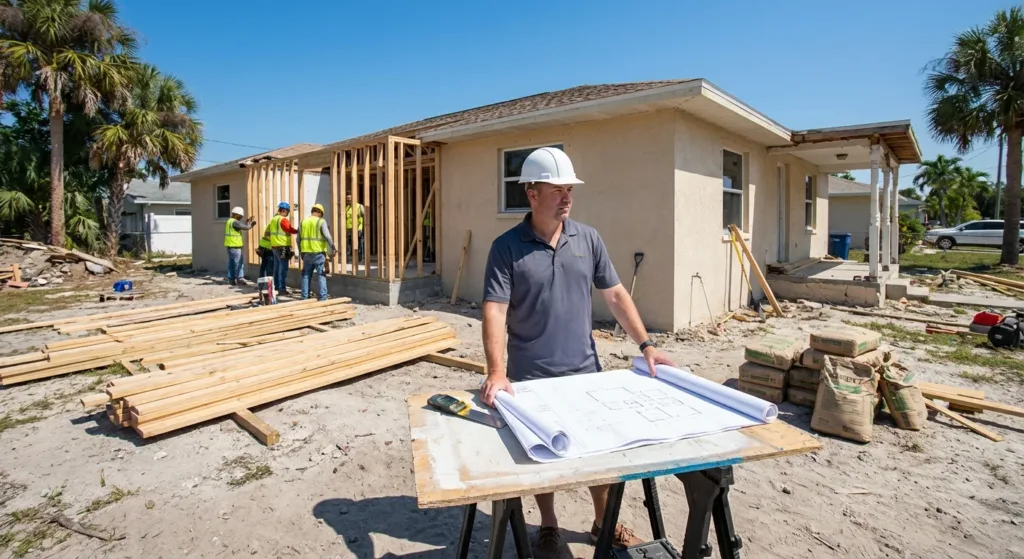
Draw schedules protect both parties during construction. Rather than handing over the entire rehab budget at closing, lenders release funds in stages as verified work gets completed. A typical structure might release draws at 25%, 50%, 75%, and final completion. You submit paid invoices and photos at each milestone.
Closing speed is where hard money shines. I have funded deals in as little as 5 to 7 days when everything lines up correctly. The typical timeline runs closer to 10 to 14 days, still dramatically faster than the 45 to 60 days many banks require. When a seller needs to close quickly or you are competing against cash buyers at auction, this speed becomes CRITICAL.
Common Uses for Hard Money Loans in Florida
Fix-and-flip projects remain the bread and butter of hard money lending. You find a property below market value, secure fast financing, complete renovations, and sell for a profit. The entire cycle typically happens within 6 to 12 months. Hard money makes this possible because banks generally refuse to finance properties that need significant repairs.
Rental property acquisitions work differently but still benefit from hard money. An investor might use a hard money loan to quickly secure a rental property, then refinance into a long-term DSCR loan once the property is stabilized. This bridge strategy lets you move fast on opportunities without waiting months for conventional approval.
Bridge loans serve investors who need temporary capital while transitioning between financing sources. Maybe you are waiting for a conventional loan approval that got delayed, or you need to close on a new property before selling your current one. Bridge financing fills these gaps without forcing you to miss opportunities.
Cash-out refinances allow investors to tap equity in properties they already own. If you bought a property years ago and it has appreciated significantly, you might pull that equity out to fund your next deal. This keeps your portfolio growing without requiring fresh capital from outside sources.
Buying auction or distressed properties almost always requires hard money. Foreclosure auctions demand cash or fast financing within days. Banks cannot move that quickly. Distressed properties often have title issues or condition problems that disqualify them from conventional financing entirely.
Hard Money Loan Rates and Terms in Florida (2026)
Interest rates for hard money loans in Florida typically range from 9.5% to 15%, with most funded loans landing between 10% and 11% for well-qualified borrowers. According to industry data from Q1 2025, the statewide average was 10.69% across nearly 1,000 short-term loans. Regional variation exists, with Southeast Florida averaging 10.70% and Central Florida coming in slightly lower at 10.55%.
Loan terms most commonly run 12 months for standard flip projects. Some lenders offer 6-month terms for quick renovations or 18 to 24 months for larger projects. Commercial bridge loans might extend to 36 months. The key is matching the term length to your realistic project timeline, including buffer time for unexpected delays.
Loan-to-value ratios generally cap between 60% and 75% of purchase price or current value. Some lenders offering aggressive programs might go to 80% or even 90% LTV for experienced investors with strong credit. The after-repair value (ARV) also factors in, with many lenders lending up to 70% to 75% of ARV on flip projects. This means a property with a $400,000 ARV could potentially support around $300,000 in total financing.
Origination fees, often called points, typically run 2% to 3% of the loan amount. The statewide average in early 2025 was 2.4%. Lower fees around 1.5% exist for experienced borrowers at larger lenders, while smaller or more specialized lenders might charge 3% or more. Additional closing costs for processing, appraisal, title, and legal work add another 2% to 4% on top.
Interest-only payments keep monthly costs manageable during the holding period. You pay only the interest each month, with the entire principal due as a balloon payment at maturity. On a $400,000 loan at 11%, that is roughly $3,667 per month in interest. No principal reduction happens until you pay off the loan through sale or refinance.
Hard Money Loan Requirements in Florida
Credit score expectations vary by lender, but most want to see at least a 620 FICO score. This is much lower than the 680 to 740 that conventional lenders require. Some private lenders will work with scores down to 550 if the deal is strong enough, though you will pay higher rates and need more equity.
Experience matters more than you might expect. First-time investors typically face higher rates and stricter requirements, including mandatory use of licensed contractors. Experienced investors with documented track records get better terms. I ask borrowers about their previous deals, including purchase prices, sale prices, renovation costs, and how loans performed.
Down payment requirements usually fall between 20% and 30% of the after-repair value. The exact amount depends on your experience, credit profile, and the specific deal. A well-qualified investor on a solid project might only need 20% down, while a newer investor on a riskier deal could need 30% or more.
Property types eligible for hard money funding include single-family homes, multifamily properties, townhomes, condos, and some commercial buildings. Mixed-use properties and vacant land are more challenging and not all lenders will touch them. Properties in flood zones require additional insurance considerations. Condition does not disqualify a property the way it would with conventional financing, since the whole point of many hard money loans is funding renovations on distressed properties.
Documentation requirements have increased under Florida’s updated regulations. Expect to provide bank statements showing proof of down payment and reserves, a detailed scope of work for renovation projects, contractor bids, purchase contracts, and a clear exit strategy explaining how you plan to repay the loan.
Florida Hard Money Lenders vs Traditional Banks
Speed and approval differences are MASSIVE. Banks need 30 to 60 days minimum, often longer. They require extensive documentation, multiple rounds of underwriting review, and approval from committees that meet on their own schedules. Hard money lenders can often provide term sheets within 24 hours and fund loans in one to two weeks. When you are competing for properties, this speed is a weapon.
Credit and income flexibility separates the two lending types completely. Banks want W-2 income, two years of tax returns, debt-to-income ratios below certain thresholds, and credit scores above 680 or higher. Hard money lenders evaluate the deal first and the borrower second. Self-employed investors, those with unconventional income, or borrowers recovering from credit events can still access capital if the property math works.
Property condition requirements differ substantially. Banks will not finance a property with a failing roof, outdated electrical, or major structural issues. They require the home to meet minimum condition standards before closing. Hard money lenders regularly fund properties that need exactly these types of repairs. The renovation is the ENTIRE point of the loan.
When do banks make sense? If you have excellent credit, documentable income, plenty of time, and the property is in good condition, conventional financing costs less. Interest rates in the 6.5% to 7.5% range beat hard money rates every time. But many investor scenarios just do not fit the bank box, which is where private lending fills the gap.
Choosing the Right Hard Money Lender in Florida
Local versus national lenders represents a real choice with tradeoffs. National lenders often have lower rates due to scale and access to cheaper capital. But they also have rigid underwriting boxes and less flexibility when deals get complicated. Local lenders know Florida markets intimately and can make faster decisions because they actually understand the neighborhoods you are investing in.
Questions to ask before borrowing: What are your current rates and origination fees? How quickly can you close? Do you fund rehab costs, and if so, what is your draw process? What happens if my project runs longer than expected? Are there extension options? A legitimate lender will answer these questions directly.
Red flags to avoid include lenders who pressure you to close immediately, refuse to provide fee breakdowns in writing, require large upfront deposits before providing loan commitments, or have no verifiable track record of funded deals. Vague answers about terms or unwillingness to provide references from past borrowers should raise concerns.
Transparent terms matter because surprises in lending always cost money. At SEP Capital, I explain every fee upfront before you commit to anything. The application costs nothing and creates no obligation. You get a clear term sheet showing exactly what the loan will cost before you ever pay a deposit.
I will also tell you if a deal does not make sense. I review comps, challenge rehab budgets that seem too low, and have talked investors out of deals that looked like money losers. I could not in good conscience let somebody get taken advantage of just because I would earn a fee on the loan. This approach has kept my default rate exceptionally low.
Hard Money Loans in Florida: Tampa and Statewide Markets
Tampa Bay
The Tampa market recorded average hard money loan rates around 10.60% in early 2025, with average loan amounts near $382,000. Tampa Bay maintains approximately 7 months of housing inventory, creating a more balanced market than the extreme seller’s conditions of 2021 to 2023. Pending sales have increased year-over-year, suggesting stabilization. For hard money borrowers, this means properties must be priced competitively to sell, but there is still solid demand for well-renovated homes.
Orlando
Orlando recorded some of the most competitive hard money rates in Florida, averaging 10.55% with average loan amounts around $377,000. The market has transitioned to approximately 8 months of inventory supply, firmly in buyer-friendly territory. Median prices have stabilized around $423,000. Tourism employment continues supporting rental demand, making Orlando attractive for both flip and hold strategies.
Jacksonville
Jacksonville was named one of the top 10 homebuying hot spots for 2026 by the National Association of Realtors. Hard money rates averaged 10.89% with average loans around $539,000. Strong employment fundamentals with unemployment at 3.8% support housing demand. About 30% of listings have experienced price reductions, indicating realistic seller expectations. Jacksonville offers compelling opportunities for rental acquisitions and flips in the $200,000 to $500,000 range.
South Florida: Miami and Fort Lauderdale
Southeast Florida including Miami posted average hard money rates of 10.70% with notably higher average loan amounts near $937,000, reflecting the concentration of larger deals and luxury investments. Miami currently has about 9.7 months of inventory, among the highest levels nationally. The ultra-luxury market above $10 million remains strong, while the broader market below $3 million faces increased competition and longer holding periods. Insurance costs have risen substantially, affecting rental cash flow projections for hold strategies.
Why Local Market Knowledge Matters
Understanding neighborhood-level dynamics determines whether your hard money loan leads to profit or pain. A lender who knows that certain Tampa ZIP codes sell faster than others, that Orlando’s tourism employment affects rental demand seasonally, or that Sarasota buyers expect different finishes than Jacksonville buyers can help you avoid expensive mistakes. Generic national lenders evaluate your deal against broad data without understanding these nuances.
Ready to Discuss Your Florida Investment?
If you are considering a hard money loan for a Florida property, I am happy to review your deal and provide honest feedback. The application process is straightforward and costs nothing. You will receive a no-obligation quote so you can make an informed decision. Apply now to get started, or reach out directly if you have questions about whether hard money is right for your situation.
The information provided here is for educational purposes only and does not constitute financial or investment advice. Always perform your own due diligence and consult with qualified professionals before making investment decisions.





Stay In Touch